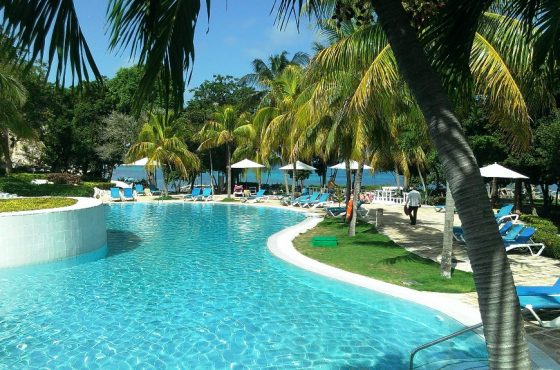
Just a plane ride away, lays the island of your dream, Barbados. Sun, sea breeze, white sandy beaches, palm trees, richness of colours, and unbelievable feeling of freedom and joy… The island abounds with exotic locations and exciting history, while the extensive variety of culture, sports and activities make Barbados the gem of the Caribbean.
The west coast holds numerous deluxe resorts. The interior highlands have several historical sites with picturesque views. Barbados also has a number of sites of architectural and natural interest that make it unique! In the interior there is a beautiful Botanical Garden with more fauna information than most similar places across the planet.
Barbados is an island in the Caribbean, northeast of Venezuela. The island is portrayed as the
Little Britain of the Caribbean because of its long association as a British colony. The name “Barbados” comes from a Portuguese explorer Pedro Campos. In 1536, he called the island Los Barbados (“The Bearded Ones”), after the appearance of the island’s fig trees, whose long hanging aerial roots resembled beards.
Barbados beaches
Barbados is a relatively flat island, shaped somewhat like an upside-down leg of ham, narrow at its northern end, its west coast almost straight, and its east coast gently curving outwards before bending back to form the south.
There are beaches everywhere:
- The East Coast: Along the East coast they are wide and wind-blown. Here the shore is pounded by the Atlantic making it a delight for the surfers who come from all over the world.
- The South and West Coasts: On the calmer South and West coasts, you may walk for miles along unbroken white sand beaches, sometimes stopping at a cluster of coral rocks jutting out to sea. All along the shore large and small beaches are broken by coral formations, the soft coral rocks weathered by the ocean surf, forming abstract sculptures pleasing to an artist’s eye.
- The North Coast: In the North, coral and sandstone cliffs rise straight out of the sea reaching up to a hundred feet in height. But even here, you will find the occasional sheltered cove.
BARBADOS’ WONDERS
Harrison’s Cave
At the heart of Barbados lays one of its greatest wonders, Harrison’s Cave. Located in the central uplands of the island, this breathtakingly beautiful, crystallized limestone cavern is a testament to nature’s mastery. Flowing streams, deep pools of crystal clear water and towering columns characterize this living cave. Gaze in wonder at the white flowstones and in awe at the beauty of the speleothems which adorn the cave. Be sure to make Harrison’s Cave your stop while in Barbados!
Baobab Trees
One of magnificent Barbados’ wonders is a baobab. The generic name honors Michel Adanson, the French naturalist and explorer who first described the tree –
Adansonia digitata. Baobabs store water inside the swollen trunk (up to 120,000 litres / 32,000 US gallons) to endure the harsh drought conditions. It was said that the baobab tree was brought to Barbados around 1738 from Guinea in Africa. Two giant trees with possibly the widest tree-trunks to be found in the Caribbean grow in Barbados! The largest can be seen in our Queen’s Park in Bridgetown. To give an example of the size of this tree of great distinction, it takes 15 adults joining with outstretched arms to cover its circumference. It is a well deserved place in the Barbados. Do not miss it!
Historic Jacobean Mansions
St. Nicholas Abbey is one of the more famous landmarks on Barbados. It is one of only three genuine Jacobean mansions in the Western Hemisphere. It is similar to the English Jacobean manor houses of the first half of the seventeenth century, the period between the Tudor and Georgian styles, beginning in the reign of James I.
St Nicholas Abbey has no church connection. It has always been a sugar plantation house. Colonel Benjamin Berringer built the house between 1650 and 1660. The exact origin of its name is not known but rumour has it that it was named after George Nicholas, husband to Berringer’s granddaughter, Susanna. Berringer was killed in a duel with his neighbor, Sir John Yeamans, who then married Berringer’s widow and claimed the abbey as his property. In 1669, The Colonel’s children took the matter to court and were awarded ownership of the property. Sir John and his wife then moved to the United States, where they helped found South Carolina.
The mansion is well-preserved, with curvilinear Dutch gables with tall finials of carved coral stone and corner chimneys. The entrance portico, Chinese Chippendale staircase and cedar panelling are later additions. The fireplaces and walled Medieval herb garden were almost certainly included in the original plans brought from England, and copied faithfully. Sugar has been grown on the plantation since 1640 and there is still the evidence of the mill and sugar making edifices. Processed on the property until 1947, the cane is now trucked eight miles to the Portvale Sugar Factory for processing. There is a rare 1930s film of life on a sugar plantation that is available for viewing. Listed by the Barbados Tourism Authority as one of the “Seven Wonders of Barbados,” the property has attracted several thousand visitors a year. Amongst the mahogany trees are box, cabbage palm, silk cotton, and avocado trees.
Morgan Lewis Mill
Morgan Lewis Windmill in St. Andrew, is the last sugar windmill to operate in Barbados. The mill stopped operating in 1947. In 1962 the mill was given to the Barbados National Trust by its owner Egbert L. Bannister for preservation as a museum.
The site was listed in the 1996 World Monuments Watch by the World Monuments Fund. Restoration began by the Barbados National Trust during the following summer. In 1997, financial support was provided by American Express for emergency repairs. The mill was dismantled for restoration, and reopened in 1999. With all its original working parts having been preserved intact, the sails were able to turn again after the project was completed, and cane was ground again after more than half a century.
It is a unique historic and architectural monument – it is one of the only two working sugar windmills in the world today. (Betty’s Hope, in Antigua, was refurbished and restored some years ago and is also functional.) During the ‘crop’ season, February through July, its sails are put in place and it operates one Sunday in each month, grinding cane and providing cane juice. The resulting cane juice is absolutely delicious! Around the interior of the mill wall is a museum of sugar mill and plantation artifacts, and an exhibition of old photographs. Visitors can climb to the top of the mill.
Bridgetown Jewish Synagogue
The
Nidhe Israel Synagogue (
Synagogue of the Scattered of Israel) is currently the only synagogue situated in Bridgetown. It also holds the distinction of being one of the oldest synagogues in the western hemisphere.
Built in the 17th century (1654) it was destroyed by hurricane in 1831, was rebuilt, fell into disrepair and was sold in 1929. In 1983, it was bought back by the Jewish community and was restored to its present state with its beautiful Gothic arches, and is now a Barbados National Trust protected building and an active synagogue.
About 300 Jewish people of Recife, Brazil, persecuted by the Dutch, settled in Barbados in the 1660′s. Skilled in the sugar industry, they quickly introduced the crop and passed on their skills in cultivation and production to the Barbados land owners. With their help Barbados went on to become one of the world’s major sugar producers.
Cannon Galore
The Caribbean is still full of secrets. One recently revealed is that Barbados has the world’s rarest collection of 17th century English iron cannon. Not too long ago it was decided to create a National Ordnance Collection of all the old guns on the island and to date more than 400 have been unearthed.
“The island is littered with old cannon”, said Major Michael Hartland, who is the driving force behind this collection’s acquisition. The reason there were so many guns on the island was that during the 17th & 18th centuries Barbados was an important military base which the British used to protect their interests in the southern Caribbean.
When a nucleus of cannon had been collected, Charles Trollope, an English apple farmer (who also happens to be a world authority on ordnance), was invited to come to Barbados and catalogue the collection. He arrived armed with copies of the Royal Armory archives now stored in the Tower of London. The British kept meticulous records of all cannon shipped to and from the West Indies. The oldest cannon found was cast in 1620 and the youngest, dated 1870 is one of the rarest called the Victoria Gun. Twenty-six of the most important pieces in the collection are mounted in front of the Main Guard House and make a fine photographic display.
Flying Fish
Do flying fish fly? Yes and no. Flying fish can break through the surface of the water and fly distances of up to 100yd at about 30mi/h, but they do not actually fly the same way as birds, because birds vibrate their wings during flight. Instead, the flying fish gets its power and speed from its tail fin, which it moves from side to side with powerful strokes.
Grapefruit Tree
The grapefruit (
Citrus paradisi), is a subtropical citrus tree known for its sour fruit, an 18th-century hybrid first bred in Barbados. Its parents were Shaddock and Sweet Orange, “immigrants” from across the Asian Sea. As a result, the “Forbidden Fruit” (as it was named many moons ago) was born for the first time! The name was changed to “Grapefruit” because it grows in large “grape-like clusters”. This original Barbadian fruit has now become a world wide favourite.
Barbados
Barbados is an island country in the Lesser Antilles. It is 34km in length and 23km in width. Barbados is outside of the principal Atlantic hurricane belt.
Barbados was initially visited by the Spanish around the late 1400s to early 1500s and first appears on a Spanish map from 1511. The Spanish explorers may have plundered the island of whatever native peoples resided therein to become slaves. Thereafter, the Portuguese in 1536 then visited, but they too left it unclaimed. The first English ship, the
Olive Blossom, arrived in Barbados in 1625. They took possession of it in the name of ‘James, King of England’. It became an English and later British colony.
Barbados has an estimated population of over 280 thousand, with around 97,000 living in or around Bridgetown, the largest city and the country’s capital. In 1966, Barbados became an independent state and Commonwealth realm, retaining Queen Elizabeth II as Head of State.
Barbados is one of the Caribbean’s leading tourist destinations and is one of the most developed islands in the region, with an HDI number of 0.788. In 2010 Barbados also ranked in the top 3 in The Americas on Transparency International’s Corruption Perception Index beating out Chile in 3rd, and coming after Canada in the top spot.
Bridgetown
Bridgetown is the capital of Barbados and the only city on Barbados. It is the port of call for many cruise ships and is known for its duty-free shopping as much as for its more cultural and historical attractions.
On 25 June 2011, Historic Bridgetown and its Garrison were added as a World Heritage Site of UNESCO.
Barbados has a well-deserved reputation for producing excellent rum, e.g., Mount Gay. Rum distilleries are usually open for tours, and typically offer samples and product for sale at prices often equal to the best found anywhere else. Do not forget to bring one home!
Book you paradise vacation to Barbados with Altair Travel!
For reservation and information please contact Altair Travel at 416-633-9404December 31, 2013/ altair / Caribbean Vacations
Just a plane ride away, lays the island of your dream, Barbados. Sun, sea breeze, white sandy beaches, palm trees, richness of colours, and unbelievable feeling of freedom and joy… The island abounds with exotic locations and exciting history, while the extensive variety of culture, sports and activities make Barbados the gem of the Caribbean.
The west coast holds numerous deluxe resorts. The interior highlands have several historical sites with picturesque views. Barbados also has a number of sites of architectural and natural interest that make it unique! In the interior there is a beautiful Botanical Garden with more fauna information than most similar places across the planet.
Barbados is an island in the Caribbean, northeast of Venezuela. The island is portrayed as the Little Britain of the Caribbean because of its long association as a British colony. The name “Barbados” comes from a Portuguese explorer Pedro Campos. In 1536, he called the island Los Barbados (“The Bearded Ones”), after the appearance of the island’s fig trees, whose long hanging aerial roots resembled beards.
Barbados beaches
Barbados is a relatively flat island, shaped somewhat like an upside-down leg of ham, narrow at its northern end, its west coast almost straight, and its east coast gently curving outwards before bending back to form the south.
There are beaches everywhere:
- The East Coast: Along the East coast they are wide and wind-blown. Here the shore is pounded by the Atlantic making it a delight for the surfers who come from all over the world.
- The South and West Coasts: On the calmer South and West coasts, you may walk for miles along unbroken white sand beaches, sometimes stopping at a cluster of coral rocks jutting out to sea. All along the shore large and small beaches are broken by coral formations, the soft coral rocks weathered by the ocean surf, forming abstract sculptures pleasing to an artist’s eye.
- The North Coast: In the North, coral and sandstone cliffs rise straight out of the sea reaching up to a hundred feet in height. But even here, you will find the occasional sheltered cove.
BARBADOS’ WONDERS
Harrison’s Cave
At the heart of Barbados lays one of its greatest wonders, Harrison’s Cave. Located in the central uplands of the island, this breathtakingly beautiful, crystallized limestone cavern is a testament to nature’s mastery. Flowing streams, deep pools of crystal clear water and towering columns characterize this living cave. Gaze in wonder at the white flowstones and in awe at the beauty of the speleothems which adorn the cave. Be sure to make Harrison’s Cave your stop while in Barbados!
Baobab Trees
One of magnificent Barbados’ wonders is a baobab. The generic name honors Michel Adanson, the French naturalist and explorer who first described the tree – Adansonia digitata. Baobabs store water inside the swollen trunk (up to 120,000 litres / 32,000 US gallons) to endure the harsh drought conditions. It was said that the baobab tree was brought to Barbados around 1738 from Guinea in Africa. Two giant trees with possibly the widest tree-trunks to be found in the Caribbean grow in Barbados! The largest can be seen in our Queen’s Park in Bridgetown. To give an example of the size of this tree of great distinction, it takes 15 adults joining with outstretched arms to cover its circumference. It is a well deserved place in the Barbados. Do not miss it!
Historic Jacobean Mansions
St. Nicholas Abbey is one of the more famous landmarks on Barbados. It is one of only three genuine Jacobean mansions in the Western Hemisphere. It is similar to the English Jacobean manor houses of the first half of the seventeenth century, the period between the Tudor and Georgian styles, beginning in the reign of James I.
St Nicholas Abbey has no church connection. It has always been a sugar plantation house. Colonel Benjamin Berringer built the house between 1650 and 1660. The exact origin of its name is not known but rumour has it that it was named after George Nicholas, husband to Berringer’s granddaughter, Susanna. Berringer was killed in a duel with his neighbor, Sir John Yeamans, who then married Berringer’s widow and claimed the abbey as his property. In 1669, The Colonel’s children took the matter to court and were awarded ownership of the property. Sir John and his wife then moved to the United States, where they helped found South Carolina.
The mansion is well-preserved, with curvilinear Dutch gables with tall finials of carved coral stone and corner chimneys. The entrance portico, Chinese Chippendale staircase and cedar panelling are later additions. The fireplaces and walled Medieval herb garden were almost certainly included in the original plans brought from England, and copied faithfully. Sugar has been grown on the plantation since 1640 and there is still the evidence of the mill and sugar making edifices. Processed on the property until 1947, the cane is now trucked eight miles to the Portvale Sugar Factory for processing. There is a rare 1930s film of life on a sugar plantation that is available for viewing. Listed by the Barbados Tourism Authority as one of the “Seven Wonders of Barbados,” the property has attracted several thousand visitors a year. Amongst the mahogany trees are box, cabbage palm, silk cotton, and avocado trees.
Morgan Lewis Mill
Morgan Lewis Windmill in St. Andrew, is the last sugar windmill to operate in Barbados. The mill stopped operating in 1947. In 1962 the mill was given to the Barbados National Trust by its owner Egbert L. Bannister for preservation as a museum.
The site was listed in the 1996 World Monuments Watch by the World Monuments Fund. Restoration began by the Barbados National Trust during the following summer. In 1997, financial support was provided by American Express for emergency repairs. The mill was dismantled for restoration, and reopened in 1999. With all its original working parts having been preserved intact, the sails were able to turn again after the project was completed, and cane was ground again after more than half a century.
It is a unique historic and architectural monument – it is one of the only two working sugar windmills in the world today. (Betty’s Hope, in Antigua, was refurbished and restored some years ago and is also functional.) During the ‘crop’ season, February through July, its sails are put in place and it operates one Sunday in each month, grinding cane and providing cane juice. The resulting cane juice is absolutely delicious! Around the interior of the mill wall is a museum of sugar mill and plantation artifacts, and an exhibition of old photographs. Visitors can climb to the top of the mill.
Bridgetown Jewish Synagogue
The Nidhe Israel Synagogue (Synagogue of the Scattered of Israel) is currently the only synagogue situated in Bridgetown. It also holds the distinction of being one of the oldest synagogues in the western hemisphere.
Built in the 17th century (1654) it was destroyed by hurricane in 1831, was rebuilt, fell into disrepair and was sold in 1929. In 1983, it was bought back by the Jewish community and was restored to its present state with its beautiful Gothic arches, and is now a Barbados National Trust protected building and an active synagogue.
About 300 Jewish people of Recife, Brazil, persecuted by the Dutch, settled in Barbados in the 1660′s. Skilled in the sugar industry, they quickly introduced the crop and passed on their skills in cultivation and production to the Barbados land owners. With their help Barbados went on to become one of the world’s major sugar producers.
Cannon Galore
The Caribbean is still full of secrets. One recently revealed is that Barbados has the world’s rarest collection of 17th century English iron cannon. Not too long ago it was decided to create a National Ordnance Collection of all the old guns on the island and to date more than 400 have been unearthed.
“The island is littered with old cannon”, said Major Michael Hartland, who is the driving force behind this collection’s acquisition. The reason there were so many guns on the island was that during the 17th & 18th centuries Barbados was an important military base which the British used to protect their interests in the southern Caribbean.
When a nucleus of cannon had been collected, Charles Trollope, an English apple farmer (who also happens to be a world authority on ordnance), was invited to come to Barbados and catalogue the collection. He arrived armed with copies of the Royal Armory archives now stored in the Tower of London. The British kept meticulous records of all cannon shipped to and from the West Indies. The oldest cannon found was cast in 1620 and the youngest, dated 1870 is one of the rarest called the Victoria Gun. Twenty-six of the most important pieces in the collection are mounted in front of the Main Guard House and make a fine photographic display.
Flying Fish
Do flying fish fly? Yes and no. Flying fish can break through the surface of the water and fly distances of up to 100yd at about 30mi/h, but they do not actually fly the same way as birds, because birds vibrate their wings during flight. Instead, the flying fish gets its power and speed from its tail fin, which it moves from side to side with powerful strokes.
Grapefruit Tree
The grapefruit (Citrus paradisi), is a subtropical citrus tree known for its sour fruit, an 18th-century hybrid first bred in Barbados. Its parents were Shaddock and Sweet Orange, “immigrants” from across the Asian Sea. As a result, the “Forbidden Fruit” (as it was named many moons ago) was born for the first time! The name was changed to “Grapefruit” because it grows in large “grape-like clusters”. This original Barbadian fruit has now become a world wide favourite.
Barbados
Barbados is an island country in the Lesser Antilles. It is 34km in length and 23km in width. Barbados is outside of the principal Atlantic hurricane belt.
Barbados was initially visited by the Spanish around the late 1400s to early 1500s and first appears on a Spanish map from 1511. The Spanish explorers may have plundered the island of whatever native peoples resided therein to become slaves. Thereafter, the Portuguese in 1536 then visited, but they too left it unclaimed. The first English ship, the Olive Blossom, arrived in Barbados in 1625. They took possession of it in the name of ‘James, King of England’. It became an English and later British colony.
Barbados has an estimated population of over 280 thousand, with around 97,000 living in or around Bridgetown, the largest city and the country’s capital. In 1966, Barbados became an independent state and Commonwealth realm, retaining Queen Elizabeth II as Head of State.
Barbados is one of the Caribbean’s leading tourist destinations and is one of the most developed islands in the region, with an HDI number of 0.788. In 2010 Barbados also ranked in the top 3 in The Americas on Transparency International’s Corruption Perception Index beating out Chile in 3rd, and coming after Canada in the top spot.
Bridgetown
Bridgetown is the capital of Barbados and the only city on Barbados. It is the port of call for many cruise ships and is known for its duty-free shopping as much as for its more cultural and historical attractions. On 25 June 2011, Historic Bridgetown and its Garrison were added as a World Heritage Site of UNESCO.
Barbados has a well-deserved reputation for producing excellent rum, e.g., Mount Gay. Rum distilleries are usually open for tours, and typically offer samples and product for sale at prices often equal to the best found anywhere else. Do not forget to bring one home!
Book you paradise vacation to Barbados with Altair Travel!
For reservation and information please contact Altair Travel at 416-633-9404
Tags All Inclusive Caribbean VacationsBarbados – Paradise on Earth
top